Our Services
for the Pharmaceutical Industry
Please click the +-sign to read more.
• In vitro Metabolism
The lead optimisation phase often includes soft spot Met ID in human and toxicity or pharmacological species to understand metabolic instability. When choosing a candidate drug to progress through development phase, generation of a more complete in vitro cross species Met ID data set is crucial. It is the best tool at this stage to understand similarities and discrepancies between human and toxicity species, in terms of metabolic pathways and as step 1 in the “Metabolites in Safety Testing” evaluation.
We have core expertise in performing in vitro Met ID and metabolic stability (in vitro CLint) designed for candidate drug selection or on candidate drugs prior to FTIM.
We also know how to evaluate existing in vitro data and advice on next step how to proceed mitigating risks of having a MIST issue later on.
The in vitro metabolic stability and Met ID can be performed in different metabolic systems, species and gender depending on the question.
- Metabolic Stability
Metabolic stability in vitro (in vitroCLint) data can be used to evaluate how quickly a candidate drug will be eliminated by enzymes through biotransformation.
Identifying candidates with favourable pharmacokinetics (which is a result of, e.g., metabolism) early in discovery helps accelerating development, reduce costs, and support risk-based decision making. Metabolic stability studies are also a valuable tool for optimizing species selection in non-clinical studies and improving predictability in humans. - Metabolite Identification (Met ID)
Met ID plays a crucial role at multiple stages of drug discovery and development. In discovery in vitro Met ID enables soft spot identification and after candidate selection a cross-species comparison is required prior to FTIM to among other reasons support the selection of appropriate toxicity species and studies. The results might trigger non-clinical in vivo Met ID to confirm if species discrepancies are true or due to in vitro phenomena (lack of certain enzymes etc).
The systems used are liver microsomes, S9 and/or cryopreserved hepatocytes. For specific questions there are microsomes and S9 available for other tissues as well, e.g. skin. For each system and biotransformation of interest relevant cofactors are used.We perform in vitro Met ID designed for candidate drug selection or on candidate drugs prior to FTIM. U/HPLC coupled to high resolution mass spectrometry (QE-Orbitrap-MS) is majorly used, which may be supported by additional detection techniques such as LC-UV if required. Data processing is performed by software-aided data mining combined with expert knowledge in biotransformation.We also provide interpretation of the data, identification of potential issues going ahead and may suggest what could be the next step.
- Recombinant Enzymes
Recombinant enzymes (Phase I and Phase II) assays provide information into which drug-metabolizing enzymes are responsible for the metabolism of a compound. These studies can also support in vivo data and support DDI investigations, offering a clearer understanding of metabolic pathways and potential safety risks.In addition to cytochrome P450 (CYP) enzymes, we perform reaction phenotyping studies to evaluate other drug-metabolizing enzymes that may be important to investigate, such as non-CYP oxidases (FMO, MAO, AO), carboxylesterases, uridine 5′-diphospho-glucuronosyltransferases (UGT), sulfotransferases (SULT) as well as sulfatase (STS). - Reactive Metabolite Assessment
Unexpected drug toxicity can arise from reactive metabolites that bind to proteins or DNA. Because of their short-lived nature, these metabolites are stabilised with trapping agents such as GSH, KCN, methoxylamine, guanosine or SCA before analysis. The trapping is performed in S9 or microsomal incubations fortified with the trapping agent and relevant cofactors.Using LC-HRMS, we deliver accurate, high-quality data to characterise reactive metabolite formation. - Acyl Glucuronides Investigation
Acyl glucuronides formed from carboxylic acid-containing drugs or as a result of carboxylation and glucuronidation may cause adverse drug reactions through covalent protein binding. The risk assessment of acyl glucuronides are among others based on the stability of the acyl glucuronide, e.g. the rate/ability of acyl migration. Our assays support the investigation of acyl glucuronide formation and stability, to support the assessment of the risk of toxicity associated with these potentially reactive metabolites during drug development.
• IND enabling Met ID
An IND-enabling metabolite identification (Met ID) package should provide a comprehensive understanding of the metabolic fate of a drug candidate and establish a foundation for the interpretation of human pharmacokinetics, safety studies, and future MIST assessments. A key component of this package is cross-species metabolite profiling, in which metabolites formed in humans are compared with those observed in the nonclinical species selected for toxicology testing. These studies help determine whether the toxicology species provide adequate coverage of human metabolites and enable early identification of human-unique or disproportionately abundant human metabolites that may require further evaluation.
The quality of cross-species comparisons depends on the generation of representative human metabolite profiles. Consequently, characterization of the enzymes involved in major metabolic pathways is an important element of IND-enabling investigations. In particular, enzyme identification efforts should focus on determining whether polymorphic drug-metabolizing enzymes contribute significantly to the formation of major circulating metabolites or to overall drug clearance. Enzymes such as CYP2D6, CYP2C19, CYP2C9, CYP2B6, and CYP2A6 can exhibit substantial interindividual variability, potentially resulting in marked differences in metabolite profiles across individuals. Identification of such pathways prior to first-time-in-human studies can support the interpretation of early clinical metabolite data, improve understanding of pharmacokinetic variability, and help ensure that human metabolite profiles used for MIST assessments are representative of the intended patient population.
While a focused evaluation of polymorphic enzymes may be sufficient during the IND-enabling phase, more comprehensive enzyme phenotyping is often warranted during later stages of development. Detailed enzyme identification supports the assessment of drug–drug interaction risk, particularly in studies involving concomitant medications that may inhibit or induce specific metabolic pathways. Such information is essential for understanding potential changes in parent drug and metabolite exposure under clinically relevant conditions and for ensuring that metabolite safety assessments remain applicable throughout development.
Taken together, an IND-enabling Met ID package should integrate cross-species metabolite profiling with targeted enzyme identification to establish a robust understanding of metabolic pathways, support the selection of relevant nonclinical species, and provide confidence that subsequent MIST evaluations are based on metabolite profiles that accurately reflect human exposure.
- Cross-species comparison in hepatocytes and/or liver microsomes; human and safety species of choice (general, reprotoxicity, carcinogenicity)
- Enzyme ID for polymorphic enzymes CYP2D6, CYP2C19, CYP2C9, CYP2B6, and CYP2A6
• Metabolite profiling and characterisation in non-clinical species
Met ID in non-clinical species early on can be performed to confirm or retract potential discrepancies between species in vitro. The plasma metabolite profile (circulating metabolites) many times reflect the metabolic pathways in vivo to a larger extent than in vitro data despite the fact that not all metabolites formed and excreted are present at all or at detectable levels in plasma.
We perform in vivo Met ID studies as part of MIST evaluation but also exploratory and as problem solving activities. We handle blood, plasma, urine, feces, bile, tissues and other body fluids (e.g. saliva, humour).
• Human metabolite profiling and characterisation (circulating and excreted metabolites)
The most important data is Met ID in vivo in human. First available samples comes with the SAD study. It is a single dose but still very useful particularly if there is a need for data as soon as possible. Sometimes also from a dose perspective SAD samples are more useful. In addition to plasma, urine Met ID is an important tool for some compounds to get a better overview of the metbolic pathways and often supports the Met ID in plasma where lower levels might be seen.
From MIST perspective repeated dose studies are used where the metabolite profile in MAD samples “set the scene” of which metabolites require adequate exposure in toxicity species.
We perform Met ID in FIH samples. We can guide you through the need for your project.
• MIST analysis (exposure comparison between human and non-clinical safety species)
The exposure comparison of human metabolites between human and toxicity species is performed to understand if human metabolites are adequately exposed in the toxicity species.
To perform and evaluate exposure comparison in the best way several aspects have to be considered.
We know MIST analysis and perform exposure comparison utilising samples from repeated dose studies. We can guide you through the best approach for your project.
• Radiolabel-assisted metabolite profiling and characterisation in samples from human and preclinical A(D)ME studies
Radiolabel-assisted metabolite profiling is important to achieve a more quantitative understanding of the metabolism and excretion than is possible with other detection methods.
As experts in radiolabel-assisted metabolite profiling and characterisation we are aware of all the pitfalls related to such applications.
We can support you in:
- advice on labelling position from a metabolic perspective in collaboration with radiochemists
- advice on concentrations in vitro, doses in vivo including specific activities required to obtain useful data
- LC-MS method development suitable for both on-line and off-line radioactivity monitoring (RAM)
- recovery-based sample preparation development for any biological matrix
- recovery determinations
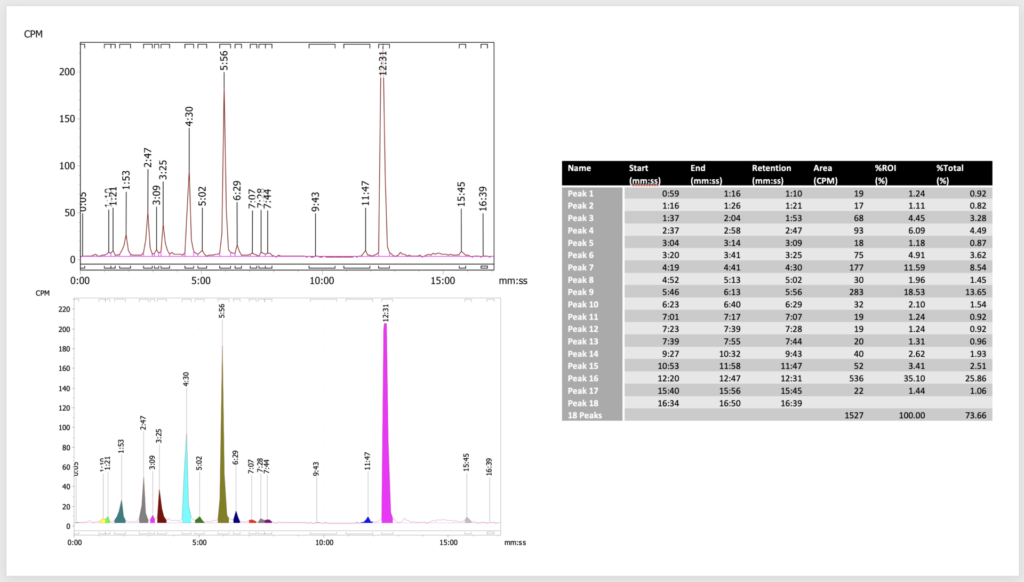
- metabolite profiling using on-line (parallel coupled) RAM or fraction collection to 96-well LUMA plates with offline RAM in TopCount.
- metabolite characterisation using HRMS based on radiochromatograms
- MS/RAM response factor determinations in any matrix/sample
- radioactivity determination in organs from animals dosed with 14C- or 3H-compounds.
- outsourcing in life ADME studies
- Full Met ID in samples from A(D)ME study performed in any species (rodent, non-rodent, or human)
Against this we can support you in any Met ID study or problem-solving activity utilising 14C or 3H.
• Non-GLP bioanalysis